
Somewhere Between Teaching and being Taught: SEA - Teacher Program Batch 11 Journey.
.jpeg)

"God didn't promise an easy journey, but He did promise to walk with you through it."
- Isaiah 43 : 2 -
.png)
SEA-Teacher Program Batch 11 | Selfisina Samadara
See you when I sea you, Philippines.
March 2026, for me, was much more than just an opportunity given to a 20-year-old pre-service teacher to explore, improve, and experience what teaching in another country looks like. It became a month of personal growth, fulfillment, and self-discovery. In March 2026, I started to find my purpose and discovered joy, not only in teaching but also in building connections with the people I now call family.
HALO! SEMOGA KABARMU BAIK YA^^
Hello! My name is Selfisina Samadara, currently a third-year student majoring in English Education at Nusa Cendana University.
For the longest time, being a university student felt merely like a label, with nothing particularly special attached to it. Not only that, I lacked the confidence throughout my life to apply for major academic opportunities, such as independently joining competitions. It was always alongside my peers, so whenever we succeeded, I gave the credit to them and believed that my contribution was simply luck. So, if you were to ask 19-year-old me, she would have said that she had not proven anything yet, not to anyone else, but to herself. Then I reached the big two-zero. Suddenly, it felt like now or never. I knew I would regret it after I graduated if I continued to remain in my comfort zone. Driven by the desire to achieve something I could proudly say I did, I applied for the SEA-Teacher program.
I still remember the day of the announcement. There was something deeply fulfilling about knowing that I went through the entire selection process on my own with God's blessing. Standing among many capable and ambitious individuals, I realized that being selected was more than just about luck. It reflected qualities I already have, even if I had not fully embraced them with confidence. I am beyond grateful to be part of the SEA-Teacher Program Batch 11. From the selection process to the experiences I gained during the program in the Philippines, it taught me to approach opportunities with greater poise and to acknowledge my abilities with more confidence, which I now understand as essential not only for personal growth but also for effectively guiding and managing a classroom.
Just like the title Somewhere between Teaching and Being Taught, this journey is not only about learning how teaching is practiced in another country and contributing to that environment, but also about discovering who I am becoming in the process. As the saying goes, you do not have to be great to start, but you have to start to be great. I hope my story can inspire you to apply for the next batch of the SEA-Teacher Program.


School: General Information and Academic Administration

School Profile
Don Mariano Marcos Memorial State University (DMMMSU) has several campuses across La Union, each with its own Laboratory High School. The Laboratory High School discussed here is located at the Mid La Union Campus (MLUC) in San Fernando City, because it is within this campus where I conducted English classroom observations and teaching practice.
DMMMSU—MLUC's Laboratory High School operates under the university’s College of Education. The school covers both junior high school (grades 7–10) and senior high school (grades 11–12). In terms of academic performance, the Laboratory High School has demonstrated strong viability. Its students have achieved recognition in national and international competitions, earning multiple medals and awards, which reflects the school’s emphasis on academic excellence.

Academic Support System
The academic support system at the Laboratory High School of DMMMSU-MLUC reflects the institution’s philosophy of “total human development,” emphasizing the holistic growth of both students and educators. This is demonstrated through services aligned with the university’s Student Affairs and Services, such as counseling, scholarship programs, health services, and other facilities that support students’ academic and personal development. The school also provides support and guidance that enables students to actively participate in national and international academic competitions, achieve recognition, and win awards. As a laboratory school, they further support teachers’ professional growth through continuous learning and research and development opportunities. Through this support system, the school fosters an environment where both learners and educators are able to grow and reach greater potential.

Teaching System
The teaching practices at the Laboratory High School of DMMMSU–Mid La Union Campus are largely student-centered, encouraging active participation and engagement in the learning process. Students are encouraged to express their opinions, share ideas, and take part in discussions on various topics. This aligns with the goals of the Philippine K–12 curriculum, which aims to develop students’ 21st-century skills.
Pedagogical Contents.

Due to the timing of my visit at the end of the academic year, I was only able to conduct two classroom observations in a grade 11 English class (Reading and Writing) with my cooperating teacher, Ma’am G-Yan. Additional observations in the laboratory high school outside these sessions were conducted in a grade 9 mathematics class. Despite the limited observation time, the teachers demonstrated strong subject mastery, confidence, and effective classroom management, reflecting their competence and professionalism.
Ma'am G-Yan used a student-centered approach in her classroom with elements of communicative language teaching and task-based learning. She facilitated active participation by encouraging her students to share their opinions, respond to questions, and engage in discussions throughout different parts of the lesson. Through this approach, students were guided to construct understanding through interaction and exploration rather than passive listening.
In terms of assessment, Ma’am G-Yan began her classes with diagnostic assessment through pre-activity to identify students’ prior knowledge before introducing new concepts. During the lesson, formative assessment was evident when she called on different students to explain ideas or respond to questions, ensuring equal participation while simultaneously giving generalizations. Corresponding with the K–12 curriculum’s goal of preparing students with essential life and career skills, the lesson content was connected to real-life English use, which in this particular case was through developing formal writing skills.

Teaching Plan
Plans are nothing, Planning is everything

The Philippine education system uses a K–12 curriculum, focusing on developing 21st-century skills such as critical thinking, communication, collaboration, and creativity. In my teaching plan, I combined this with Indonesia’s current curriculum, Kurikulum Merdeka, which emphasizes student-centered learning.
As an English education major, I ensured that the lesson remained focused on my field. It was designed for a grade 11 reading and writing class, with the topic of the features of academic writing. The objectives and activities were carefully planned to strengthen students’ reading comprehension and writing abilities. To support this, I applied a student-centered approach through the use of the discovery learning method for my main activity. This method also increases student talking time, which greatly amplifies critical thinking and communication skills, essential in language learning.
For the lesson structure, I followed the detailed lesson plan format. This format requires not only clear step-by-step procedures but also the teacher’s exact instructions and anticipated student responses at each stage. Compared to the format I am familiar with in Indonesia, this approach is more complex and has greater emphasis on managing classroom interaction.
In terms of instructional design, I adapted the 4As model into 6As—Activity, Analysis, Abstraction, Agreement, Application, and Assignment—to better support the discovery learning process. Finally, I incorporated both instructional media and PowerPoint slides to support the lesson. The main activity involved a role-playing task in which students acted as detectives analyzing a revised essay to identify the five features of academic writing. Inspired by a mission board concept, I created a visual aid consisting of connected envelopes, each revealing one feature after students provided the correct answers. Additional materials, such as a slide-down title and rotating learning objectives, were also included to create a more captivating classroom experience.
[ my Instructional Media ]
[ FINAL DEMONSTRATION TEACHING'S LESSON PLAN ]
Teaching Practice
Procedures of Teaching
Before starting a lesson, it is mandatory to begin with a collective prayer and a litter check around the room to reinforce positive habits and discipline. After ensuring that the students were properly seated, the class began with trigger questions related to the topic to spark curiosity and uncover their prior knowledge. This was followed by the presentation of the objectives and rules to establish clear goals and expectations.
To ensure a smooth learning process, it was essential to prepare scaffolding strategies for any possible situation in which students were struggling to provide the correct answer. When using the discovery learning method, it was also important to generalize each new piece of information discovered by the students so that everyone could remain on the same page. Throughout the lesson, verbal positive reinforcement was given while maintaining smooth transitions in between parts.
After all key parts of the topic had been discussed, a recitation session was conducted as a non-negotiable step to ensure that students truly understood the material.
Time Management and Organizing Activities
I was given a one-hour time allotment, but it was unfortunately reduced to around 40 minutes because of technical difficulties with the projector and poor internet connection. Although I was only able to cover two out of the three objectives, because I was not able to proceed with the application (individual activity) and assignment (homework) parts of the lesson plan, I still managed the remaining time well by completing the main activity, which covered all of the materials for my topic, and was able to conduct a recitation session.
Classroom Management
The main feedback given by my cooperating teacher was the need to improve my classroom management skills. With my teaching time already reduced, I still proceeded with my original method of grouping students by counting numbers from the front row, then asking students with the same number to gather together. As a result, the grouping process slowed the start of the main activity. During the activity, although discovery learning was applied, participation was not evenly distributed, as more dominant students gained more speaking time through the “first to raise a hand” rule. I recognized this issue before the lesson ended, so during the recitation session, I intentionally called on students who had not yet been given the opportunity to speak.
On a positive note, I was able to establish clear goals and expectations from the beginning of the lesson. I was also able to create a positive and supportive learning environment for the students.
Problem Solving while Teaching and Staying in the Designated School
The main problem I encountered during my demonstration teaching was technical difficulties involving the classroom projector and my poor internet connection. During my previous classroom observations, I had noticed that some of the students often assisted my cooperating teacher with projector-related issues. Because of that, I asked for their help, and they were able to resolve the projector problem so that the PowerPoint slides could be presented smoothly. To solve the internet issue, one of the students was also kind enough to lend me a modem.
No major problems occurred in relation to staying at the designated school. The staff members and our student buddies were helpful and ready to assist whenever we had questions or encountered difficulties. At other times, since the Philippines is not very different from Indonesia in many daily aspects, I was also able to navigate independently with the other students from Indonesia.

.jpeg)


Other Invaluable experiences
documentation
.jpeg)
Skill Development Classes

Sharing Indonesian Literary Work at Art and Letters Society Event
.jpeg)

[ Comic 'the legend of sasando'. a final project from one of my classes in nusa cendana university. ]


Intermission Number(s)
[Singing Indonesian Songs]

.jpeg)
.jpeg)
Introduction to Philippine culture, arranged by students of Bachelor of Early Childhood Education (BECEd)
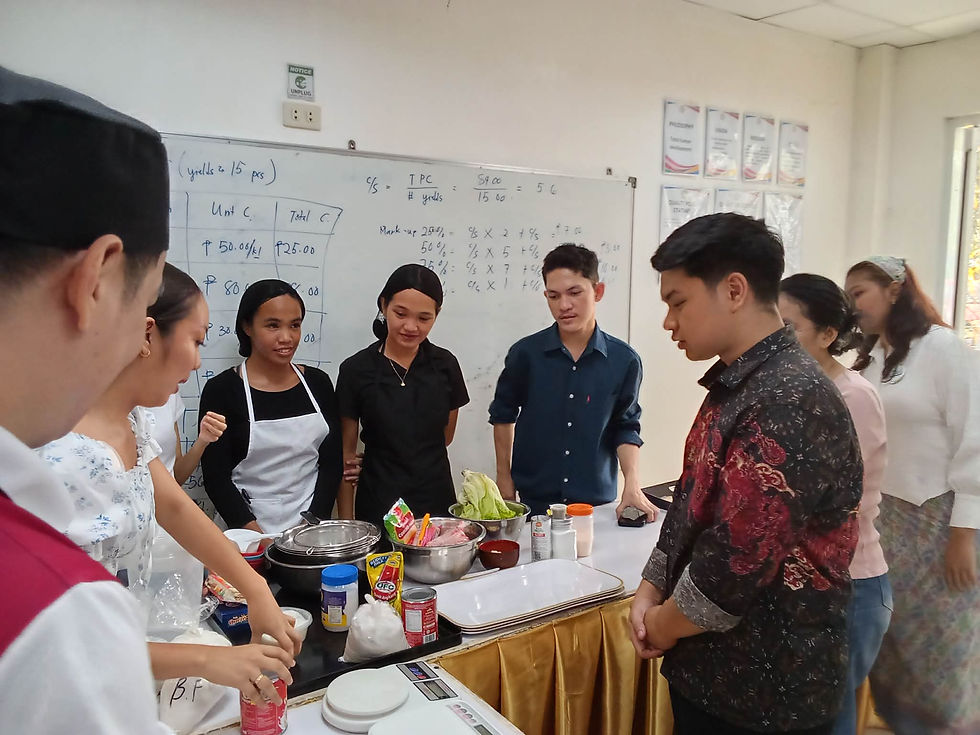
Cooking Class
Sewing Class
Digital Printing Class
Closing Program
College of Education 34th Foundation Anniversary
Summary and Suggestions
1. Purposes of Practicum
-
Gain teaching experience in real classroom setting
-
Learn about other country’s educational system
-
Support personal and professional development
-
Exposure to cross-cultural exchange
-
Expand academic and professional networks
-
Contribute teaching support to the host school
2. Procedures of Practicum
-
Introduction to the host institution and laboratory high school
-
Classroom observations to learn the teaching system and school administration
-
Preparation of teaching plans and instructional media
-
Independent demonstration teaching
-
Monitoring and evaluation by mentors on teaching performance and lessons learned
-
Farewell activities
-
Finalization of self-report/blog
3. Outcomes of Practicum
-
Improved teaching skills
-
Better understanding of lesson planning and teaching strategies
-
Greater awareness of the Philippine education system and K–12 curriculum
-
Enhanced communication, adaptability, and problem-solving skills
-
Developed new life skills
-
Stronger profile as a future educator
-
Meaningful cross-cultural experiences
-
Expanded academic and professional connections
-
Developed practical life skills through skill development classes (sewing, digital printing, and cooking)
4. Challenges of Practicum
-
Managing time effectively during implementation due to technical difficulties
-
Balancing academic responsibilities with program activities
-
Maintaining a healthy sleeping schedule amid packed agenda and tasks
5. Overall Impression
I am beyond grateful to have gained invaluable experiences and to have met some of the best people in my life through this program. I never felt like a stranger from the very first day because of the support, warmth and hospitality of the Filipino people. The experience was both personally meaningful and professionally enriching. I sincerely hope to have the opportunity to return to the Philippines and DMMMSU in the near future.
6. Suggestions for Future Improvement
-
Better alignment of the program schedule with the host institution and school’s academic calendar, so participants can gain more classroom observation and teaching opportunities
-
A more balanced daily schedule that considers participants’ workload, rest time, and personal needs
-
Clearer planning of activities to reduce last-minute schedule changes and improve time management
Let me know
what's on your mind